At FNSM World Water Day and World Meteorological Day were celebrated
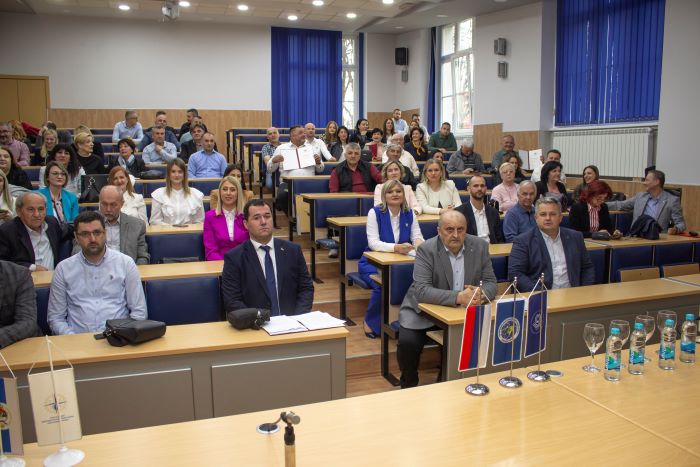
On March 24, 2025, the Faculty of Natural Sciences and Mathematics (FNSM) and the Republic Hydrometeorological Institute marked World Water Day and World Meteorological Day. This year’s themes were: Protect Our Glaciers and Establishing a Successful Early Warning System Together.
Through two panel discussions, experts from the Republic Hydrometeorological Institute, FNSM, and the Ministry of Agriculture, Forestry, and Water Management spoke about the importance of glaciers, the development of early warning systems, and their contribution to saving lives, reducing damage, and strengthening community resilience in response to increasingly frequent natural disasters. Climate change trends are becoming more pronounced, leading to greater climate risks and hazards, as well as the need for timely responses and information through early warning systems.
The year 2024 was the hottest on record. Climate change is intensifying, causing more extreme weather events in our region. Heavy rainfall, storm winds, floods, droughts, heatwaves, and wildfires are on the rise. As the planet warms, glaciers are melting faster than ever, making the water cycle more unpredictable. By overcoming obstacles to establishing an effective early warning system, we can create a safer and more resilient world. Collaborative efforts and partnerships between academia, public institutions, and the private sector have significant potential to enhance early warning systems. While government agencies—particularly hydrometeorological institutes, civil protection services, and water management agencies—must remain the authoritative sources of official warnings, cooperation with academia and the private sector can drive innovation and improve knowledge of risks and impacts. By working together, we can build an efficient early warning system that protects both human society and the environment.
Text author: Dr. Goran Trbić, Full Professor